By Marco Tartaglia | November 11, 2026
Hello everyone, my name is Marco Tartaglia and I am a young university student and aspiring marine biologist who had the pleasure of taking part in FanoUnimar’s “BLUE HACK” project. Before you start reading, I’d like to address all my fellow marine biology students who will be reading this article with a brief opening message. Guys, they need US! They need our presence, our involvement, our skills and our willingness to put ourselves to the test to really make a difference. We must use our knowledge to support those younger than us who are getting involved in these projects by providing them with peer-to-peer mentoring and passing on to them the same passion that burns within us. Using our knowledge to ensure the scientific accuracy and quality of the data collected during field trips is, after all, what we dream of doing if we want to pursue this career – so… LET’S DO IT! Now you might be wondering, what’s in it for us? Well, we gain experience; we gain the chance to put what we’re studying into practice, to finally experience what it means to be a marine biologist – and so, yes, we’re needed! I can’t wait to be joined by lots of ‘colleagues’ for FanoUnimar’s upcoming projects; I hope you enjoy reading about the ‘BLUE HACK’ project.
BLUE HACK Stage No. 4 Pesaro 11/07/2026
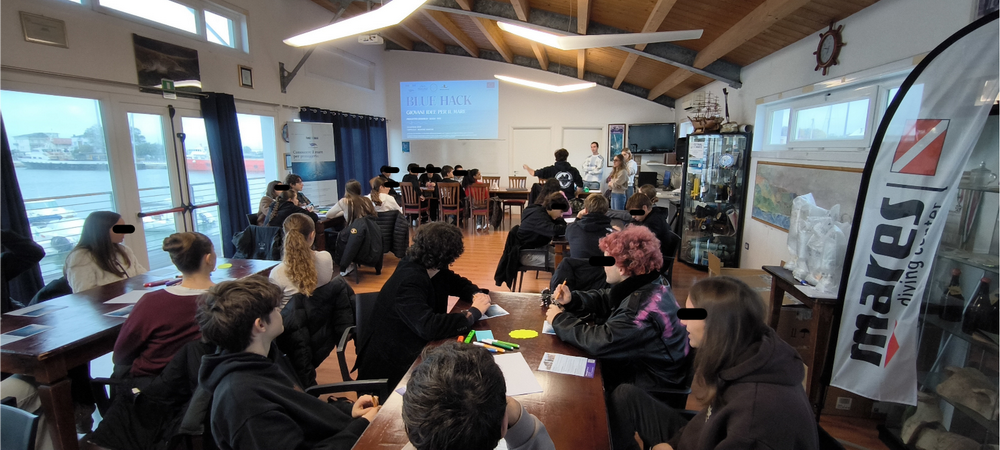
Twenty-five students from the G. Marconi Scientific High School in Pesaro, accompanied by Prof. Filippo Bargnesi, had the opportunity on Saturday 7 November 2026 to kick off the fourth stage of the “BLUE HACK” project, which has now reached the Marche region.
The event was organised by “FANOUNIMAR”, “AVVISTIAMO”, “WORLDRISE” and “MASTER WAVE DOLPHIN WATCHING” at Sub Tridente in Pesaro. The students took part in a morning of activities with a very specific aim: to make monitoring protocols accessible and enjoyable for their peers in other countries.
Alongside Prof. Filippo Bargnesi, the students were supported in their activities by Gianfranco Rossi and Sara Cerri, both representatives of FANOUNIMAR, as well as Valter Sabatini, president of Sub Tridente, and two students from Bachelor’s degree in Biological Sciences at the Marche Polytechnic Universitye: Selene Cimini and Marco Tartaglia.
BRAINSTORMING
In the early part of the morning, the students were first divided into five groups of around five students each, before embarking on a brainstorming session – a very useful activity for fostering teamwork and drawing out the best ideas from all participants. Each group focused on an activity carried out on 17 March 2026, when the students gathered on the beach at Fiorenzuola (near Pesaro) to monitor flora and fauna and clean up the environment. These initiatives are very important not only for raising young people’s awareness of environmental protection but, above all, for collecting invaluable data regarding the presence or absence of litter, the abundance of organisms, the presence of alien species and the assessment of local environmental conditions (pH, salinity, nutrient concentration, etc.).
Quadrat sampling technique
As a monitoring technique, the students opted for the ‘quadrat sampling technique’, which involves the use of squares of fixed dimensions (e.g. 1 m × 1 m) to define the monitoring area. The squares can be positioned either randomly or systematically, using transects (a straight line created by a rope or tape that serves as a guide for positioning the squares); in any case, it is essential to define the various procedures and objectives before beginning. It is also very important to define multiple monitoring areas (placing squares in different locations) and to create so-called replicates. Replicates are very important for analysing data such as the frequency or density of a particular species (or a particular type of litter).
Clean Swell and iNaturalist: simple but vital tools
To collect data, the students used two apps: Clean Swell and iNaturalist. These are two citizen science apps designed to collect data and make it available to everyone. The first allows users to record the quantity, type and location of litter collected. The second allows users to record sightings of species – both animal and plant – and the geographical location of the sighting, thereby creating data on the concentration of each species in specific locations. It is vitally important to promote citizen science projects and the use of these apps to collect ever more data and raise awareness amongst an ever-growing number of people about environmental protection.
A significant but WORRYING finding
Most of the students found the monitoring activity ‘boring’ due to the almost total absence of organisms. This is, in fact, a very important finding that provides us with information regarding the health of that ecosystem. The very low presence of organisms may be due to a wide range of factors; even a minor problem at one level of the food chain can trigger a cascade of effects throughout the entire network. The vast amount of litter found and collected certainly did not go unnoticed; this causes various problems for organisms, leading to their disappearance from certain habitats. Among the most common items of litter are cigarette ends, which are often mistaken for food by organisms, causing choking or intestinal blockages.
POSTERS
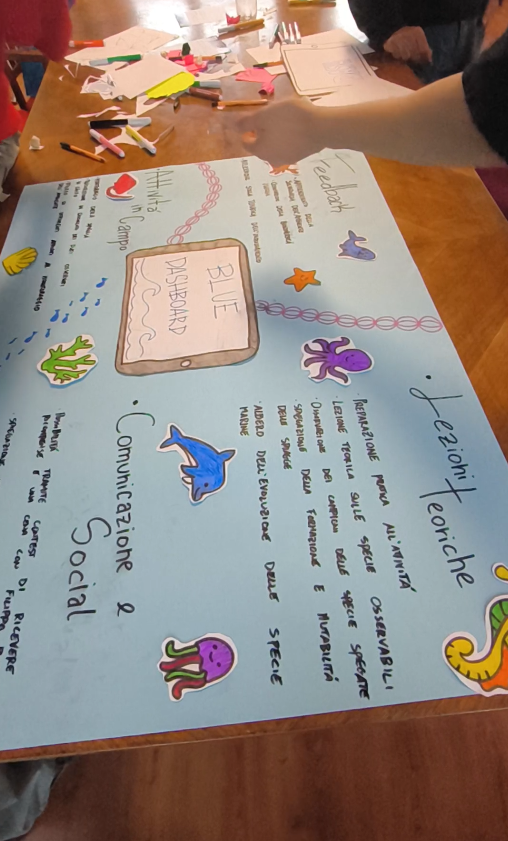
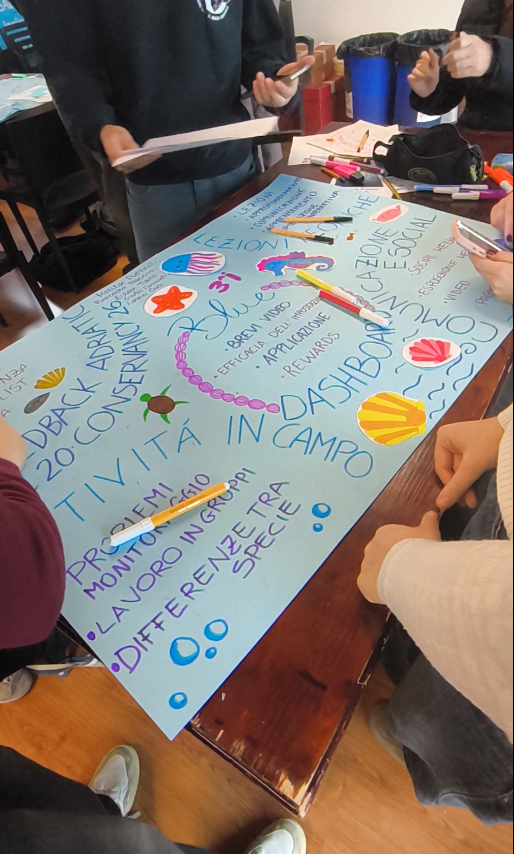
In the second part of the morning, each group transcribed the outcomes of the brainstorming session onto a poster organised into five key points:
- Feedback on the monitoring activity of 17 March 2026;
- Theoretical lessons;
- Field activities;
- Communication via social media;
- Blue Dashboard.
The aim – not only of the display boards but of the entire morning – was not merely to generate ideas for making monitoring activities accessible and enjoyable for peers from other countries; students were also asked to critically evaluate the monitoring activities they had carried out, in order to highlight any issues and resolve them.
A supporting biologist
A very common criticism was the lack of continuous support from an experienced field expert to support the activities. The presence of a supporting scientific tutor is extremely important, particularly to ensure the accuracy of the data, which is the basis of the concept of citizen science. It would be ideal to involve more and more young university students in support activities to enhance their experience and help citizen science activities grow further. Furthermore, tutors are tasked answering any questions or concerns, thereby making the activities increasingly interactive and educational (for the tutors as well).
From ideas to reality
All five groups did an excellent job of presenting some truly fascinating ideas. It was proposed to organise competitions between schools in different countries to collect data along various European coastlines. Through social media promotion using short videos in English, posts and promotional campaigns, the idea was to organise days on which several schools in different countries would gather on the beach at the same time to carry out monitoring activities in the form of a competition to make things more exciting; for example, the winning country would be the one that collected the most litter or perhaps recorded the most sightings of a particular species (perhaps one at risk of extinction or of particular scientific interest). Prizes have also been devised for the top-ranked teams, such as certificates or the chance to take part in various projects, but the greatest reward will, of course, be having done good for the environment and having collected a wealth of data for science.
Blue Dashboard
Each group was also tasked with devising improvements for ‘Blue Dashboard’, an online platform that consolidates data from citizen science projects (pollution levels, presence and absence of organisms, etc.) in order to assess the health of Europe’s coastlines. A very popular idea was to make the platform usable offline as well, so that users could access it and record data as drafts, to be finalised once an internet connection was restored.
The challenge to protect Europe’s coastlines has only just begun: the sea needs fresh energy, and we’re ready to head down to the beach. We look forward to seeing you at the next stages with FanoUniMar!